TruMouse Pro combines 144-channel RFID identity recognition with automated video analysis to track up to 20 individually identified mice simultaneously, in their home environment.
Existing tools force a trade-off between identity reliability and experimental scale.
In group-housed settings, video-only systems like DeepLabCut cannot reliably maintain individual identity across occlusions and crossings. Long-term experiments accumulate identity-switching errors that corrupt downstream analysis.
Most commercial behavioural systems are designed for single-animal paradigms or small groups. Scaling to colony-level experiments โ where social structure emerges โ has historically required manual observation or compromised tracking.
A 144-channel RFID floor array provides continuous, identity-certain localisation for up to 20 animals simultaneously โ resolving both problems within a single integrated system designed for long-term home-cage deployment.
Every output carries an identity label. Every identity label is RFID-verified.
144 reader units arranged in a 12 ร 12 grid beneath the arena floor. Each subcutaneously implanted tag is read continuously, providing ground-truth spatial position and identity for every animal โ regardless of occlusion or grouping.
Global-shutter industrial cameras with infrared illumination record high-frame-rate footage synchronised to RFID timestamps. A proprietary algorithm provides fast and accurate matching of identities to trajectories, while maintaining full compatibility with DeepLabCut.
A proprietary matching algorithm fuses RFID identity signals with video tracklets, producing a unified dataset where every pose, every trajectory, and every social interaction is attributed to a named individual. 41 metrics are computed automatically.
Native DeepLabCut compatibility. TruMouse Pro extends DLC's pose estimation with reliable identity labels โ addressing the identity-switching problem that limits DLC in group-housed settings.
Inspired by Live Mouse Tracker. Adopting a similar approach to this outstanding open-source paradigm, we deliver a complete, out-of-the-box solution so your laboratory can focus entirely on scientific research, freeing you from the burdens of hardware assembly and parameter troubleshooting.
Output is structured CSV and annotated video โ ready for direct import into Python, R, GraphPad Prism, or any downstream analysis tool.
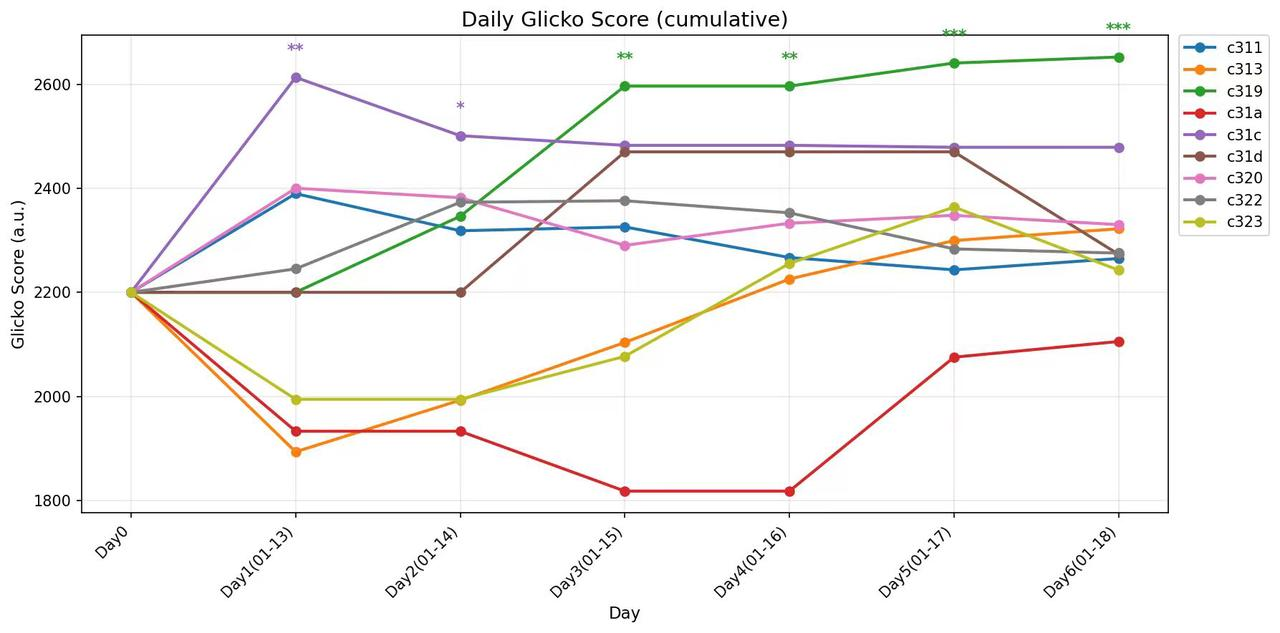
Glicko Score social hierarchy, 10 mice. Stable dominance ranking emerges within days of continuous home-cage recording โ replicating and extending the paradigm established by Shemesh et al. (2013) and the Live Mouse Tracker (de Chaumont et al., 2019) at larger colony scale. Data exported directly from the TruMouse Pro analysis pipeline.
TruMouse Pro was built to solve real experimental problems โ and tested against them.
Three TruMouse Pro systems are currently running continuously in neuroscience research laboratories, supporting active experimental programs in social behaviour and neurological disease models.
The system was designed and iterated by a team with direct experience in long-term rodent behavioural studies. Every design decision โ from the RFID floor density to the output format โ reflects the practical constraints of real laboratory work.
The Pro version hardware architecture is engineered for year-scale continuous operation. The data transmission and power infrastructure has been validated for multi-week uninterrupted recording sessions.
Every deployment includes on-site installation, system commissioning, and a 6-month trial period with direct technical support from the core development team. Pricing is available upon request and is designed to fit within standard research equipment budgets.
TruMouse Pro builds upon and extends continuous tracking and behavioural analysis frameworks developed by the community.
Weissbrod, A., Shemesh, Y., et al. (2013). "Automated long-term tracking and social behavioural phenotyping of animal colonies within a semi-natural environment." Nature Communications, 4, 2018.
Shemesh, Y., et al. (2013). "High-order social interactions in groups of mice." eLife, 2, e00759.
de Chaumont, F., Ey, E., Torquet, N., et al. (2019). "Real-time analysis of the behaviour of groups of mice via a depth-sensing camera and machine learning." Nature Biomedical Engineering, 3, 930โ942.
Mathis, A., et al. (2018). "DeepLabCut: markerless pose estimation of user-defined body parts with deep learning." Nature Neuroscience, 21, 1281โ1289.
Gammell, M. P., et al. (2003). "David's score: a more appropriate dominance ranking method than Clutton-Brock et al.'s index." Animal Behaviour, 66(3), 601โ605.
Glickman, M. E. (1999). "Parameter estimation in large dynamic paired comparison experiments." Journal of the Royal Statistical Society: Series C (Applied Statistics), 48(3), 377โ394.
TruMouse Pro covers colony-scale behaviour. For single-animal assays and chronic stress modelling, we've built โ or partnered on โ two complementary tools.
Zero-code desktop software for classical single-animal paradigms โ OFT, TST, NOR, EPM, Y-Maze. Batch video analysis, local processing, GPL-3.0 on GitHub.
Explore MouseScope โ Partner ProductAutomated chronic stress platform for depression and anxiety modelling. Supports CUMS and CRS protocols with programmable, unattended stress delivery.
Explore BlueBox โWe work with each research group to understand your specific experimental requirements before any commitment. Start with a conversation.
Contact: puze.li@student.unimelb.edu.au